Let’s actually start with what I wouldn’t do if I were diagnosed with SIBO this year…
I wouldn’t rush to kill the bacteria.
I wouldn’t immediately research “SIBO-safe” diets.
I wouldn’t start a bunch of brand new supplements.
And I definitely wouldn’t assume the diagnosis itself is the “magic bullet” explanation for all of my symptoms. Which might sound surprising, especially if you’ve been told that SIBO is the problem and clearing it is the solution.
But if you’ve already tried a protocol (or maybe three), felt better for a period of time, and then slid right back into bloating, constipation, gas, or food reactions…you already know something’s missing.
I don’t want you to panic, this post isn’t about doing more. It’s about doing things strategically, so your body can actually respond and you can start feeling like yourself again.
When You’re Doing “Everything Right,” But Still Feeling Stuck
Most of the women who find me, land here after months (or even years) of doing their research and, honestly, doing everything right.
They’ve:
- Been eating healthier and “cleaner” than anyone they know
- Worked with conventional and functional providers
- Done all the testing (breath tests, colonoscopies, Celiac testing, blood labs, stool test, you name it)
- Taken the probiotics, antimicrobials, and even antibiotics
- Followed the protocols to a “T”
And yet…
Their bowel movements are still unpredictable.
They still feel 5 months pregnant by mid-afternoon.
And they’re still asking themselves, “I’m doing everything right, why do I still feel like sh*t?”
If that’s you, you didn’t fail and your body isn’t doomed.
In fact, what you’ve already tried wasn’t inherently wrong – it was incomplete. And I know that, because I’ve lived it.
My SIBO Story
I dealt with noticeable gut issues for almost 20 years. In reality, I think I was born with a fussy gut because I would keep my parents up all night with horrible painful gas as an infant. And by high school/early college, my gut had taken over my life.
Constipation that kept me in the bathroom way too long and made mornings stressful. Gas that would clear a room and left me beyond embarrassed, and belching all day long no matter what I ate.
My mind was constantly preoccupied with how my gut was feeling, whether I’d feel comfortable using the bathroom when I left my house, if I’d be able to eat anything when we traveled, and how I was only comfortable wearing a total of 5 things in my closet.
I tried all the things that are supposed to work.
- “Gut-friendly” diets like gluten-free, dairy-free, and low FODMAP
- Digestive enzymes
- Probiotics (a lot of them)
- Herbal antimicrobials
- Increasing my protein, fiber, and water intake
- Avoiding sugar
I even ran the GI-MAP stool test multiple times. And every time, the focus was the same: Clear the overgrowth. Kill the bacteria. Then you’ll feel better.
The biggest mental challenge was that sometimes, I did feel better. Just… not for long.
What was keeping me “stuck”
The very first time I treated my SIBO I paired an herbal antimicrobial protocol with a super restrictive “SIBO-friendly” diet.
I started to feel a bit better – my gas started to go away, I wasn’t quite so bloated – but I still couldn’t go to the bathroom without popping a couple Swiss Kriss herbal laxatives the night before (and even that wasn’t guaranteed to work).
But after I finished the protocol and started to eat freely again, the symptoms started creeping back in. Cue the feelings of isolation, distrust, defeat, and hopelessness. Was I ever going to feel normal again?!?
It took me 8 more years, 2 more practitioners, and hundreds (if not thousands) of dollars to figure out what was missing and finally get rid of my SIBO for good – I don’t want you to have to go through that, so let’s break down what I learned.
Why clearing the bacteria wasn’t enough
I ran three GI-MAPs – two on myself, and one with another naturopath I was working with – before it finally clicked.
After each test, I hyperfocused on getting rid of the overgrowth and completely glossed over what mattered just as much (if not more):
- Extremely low protective bacteria
- Poor digestion (low stomach acid and sluggish bile flow)
- A taxed gut immune system
- Signs my liver and estrogen detox pathways were struggling
Don’t get me wrong, addressing the bacterial or fungal overgrowth is important, but without supporting the rest of the system any relief I felt was not going to last. And that’s because I wasn’t correcting the issues that allowed the SIBO to exist in the first place.
Remember, SIBO is a symptom of deeper dysfunction – not a root cause.
So, if I recently found out I had SIBO, I wouldn’t ask:
“How do I get rid of this as fast as possible?”
Instead, I’d ask:
“What created the environment for this to develop and how do I change that?”
That simple mindset shift is the reason I’ve been SIBO-free for 4 years. And it’s the exact framework I use with all of my clients today.
Exactly what I’d do if I were diagnosed with SIBO today
OK, let’s get into it.
If I were diagnosed with SIBO today, the very first thing I would do is slow things down and zoom out.
This part often gets skipped because people are desperate to feel better. I get that urgency deeply. I lived in it for years. But urgency without strategy is exactly what keeps people stuck in the relapse loop.
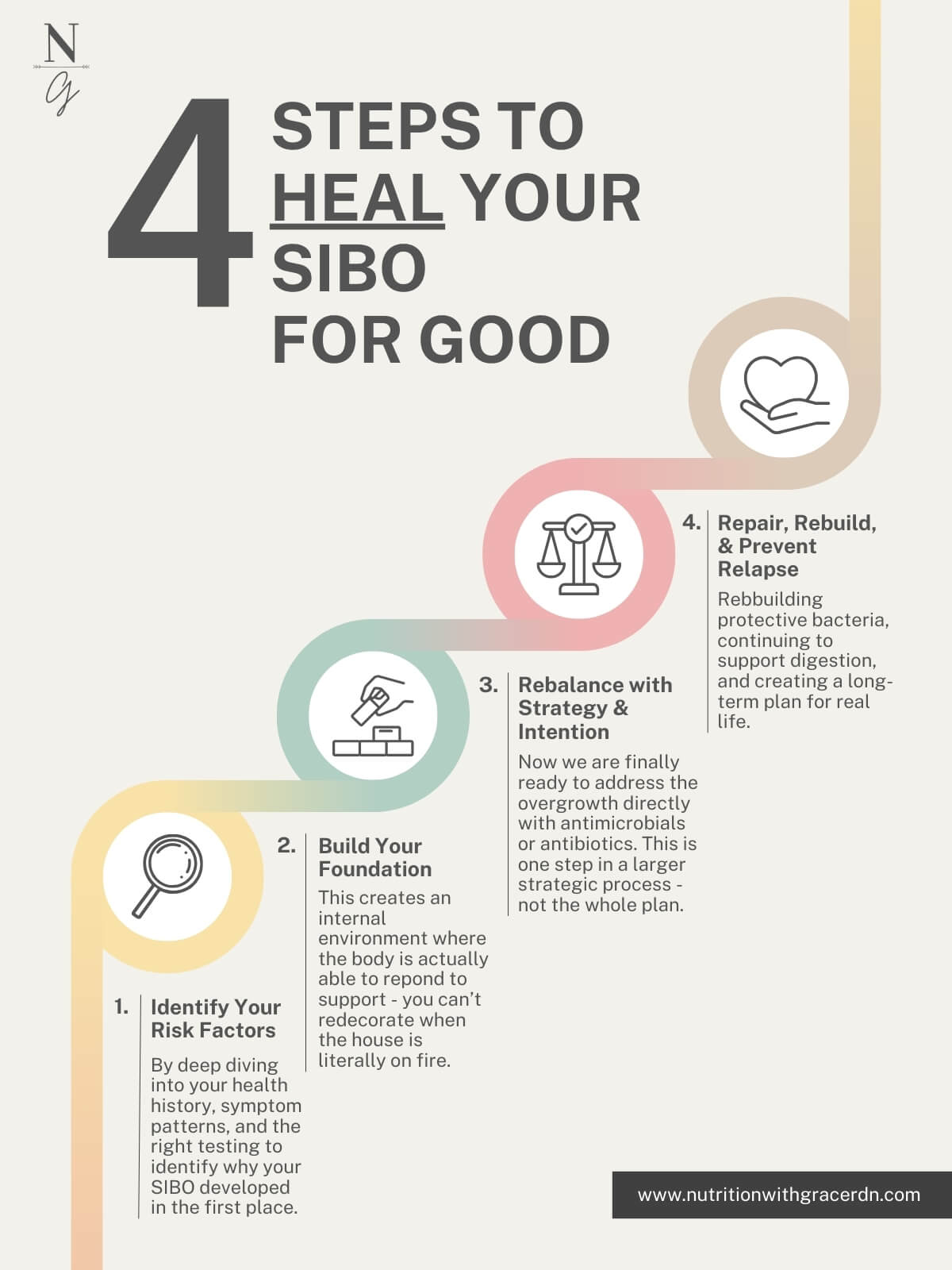
Step 1: Identify the Factors That Created the Perfect Environment for SIBO
Before I touched a single antimicrobial, I would want to understand what set the stage for SIBO to develop in my body.
For many people, this looks like years of subtle constipation or slowed motility that was normalized as “just how my body works.” Others have a history of frequent antibiotic use, food poisoning, concussions, or chronic stress that quietly disrupted gut-brain communication.
And almost everyone I work with has some degree of impaired digestion. I’m talking about low stomach acid, poor bile flow, or inadequate enzyme output – even if they’ve never been told that explicitly.
Digestion is not one isolated step. It’s a chain reaction. When food isn’t properly broken down in the stomach or small intestine, it creates the perfect conditions for fermentation, gas, and bacterial overgrowth downstream. No amount of killing will override that for long.
This is why a detailed health history, symptom pattern interpretation, and the right labs (interpreted in context, not in isolation) matter so much. Not to wear out or drain your wallet, but to give us a clear roadmap.
Step 2: Build a Foundation That Makes Your Body Feel Safe and Supported
Once I understood the root causes, the next thing I would focus on is building a solid gut-healing foundation.
That includes supporting digestion so food is actually being broken down and moved through your system effectively and nutrients are being absorbed.
It includes nervous system regulation – not as a mindset exercise, but as a physiological necessity. When the body is in a constant state of threat, it deprioritizes digestion, motility, and repair. No protocol can out-supplement that.
It also means starting to boost the gut immune system, reduce inflammation, and make realistic diet and lifestyle adjustments that support healing rather than create more fear or rigidity.
This is where my approach looks very different from the standard “take this antimicrobial and probiotic and hope for the best” model. The goal here is not perfection. It’s creating an internal environment where the body is actually capable of responding to treatment instead of seeing it as a threat.
Step 3: Rebalance the Gut Strategically and Intentionally
Only after those foundations are in place would I move into addressing the overgrowth directly.
At this stage, antimicrobial or antibiotic support is necessary, but only when it’s targeted, time-bound, and paired with the foundation support outlined above. Otherwise, it becomes another short-term fix that doesn’t hold.
This is also where so many people develop fear around relapse. When killing is done without rebuilding, the body is left vulnerable. When it’s done strategically, it becomes one step in a much larger process rather than the entire plan.
Step 4: Repair, Rebuild, and Prevent Relapse
Finally, I would focus on how to sustain the relief and stay well.
That means rebuilding protective bacteria intentionally, continuing to support motility and digestion, and creating a plan for real life – travel, eating out, stressful life events, hormonal shifts, and the occasional flare without spiraling.
Healing isn’t about never having symptoms again. It’s about having the tools, awareness, and confidence to respond to your body without fear or guesswork.
Why This Approach Works When Others Haven’t
When I look back on my own journey, the problem was never that I wasn’t trying hard enough. It was that I was treating SIBO like the root cause of all of my misery instead of recognizing it as a signal.
Once I stopped asking how to get rid of my symptoms as quickly as possible and started asking what my body actually needed to function the way it was so beautifully designed to, everything changed.
This is why I’ve been able to stay SIBO-free for years and why so many of my clients are able to break free from the vicious cycle of temporary relief and relapse.
Final Thoughts
This is the exact process I use with my 1:1 clients inside Heal Your Gut Blueprint. It’s designed for people who are done guessing, done hopping from protocol to protocol, and are ready for a clear, supported strategy that makes sense for their body and their life.
You don’t need more information. You don’t need more willpower. You need a plan that addresses the full picture, which is what finally made healing possible for me.