I’m willing to bet that you fall into one of two categories:
- Your bloat and digestion magically improve whenever you go on vacation…and then completely fall apart the second you’re back at work. OR
- Your gut turns to total chaos as soon as you’re outside of your normal rhythm.
In both situations you’re eating similar foods, you’re still “trying to be healthy,” and yet the bloating, reflux, and constipation or urgency takes over.
If your gut feels moody, unpredictable, or downright random, the truth is that it’s actually not random. And it’s definitely not because you need a stricter diet or a different supplement.
What your gut is craving is a consistent routine.
Before you roll your eyes – no, this is not a “wake up at 5am, cold plunge, meditate for 45 minutes” kind of article. 😄
This is about building supportive routines that set your body and gut up for success, while fitting into your real life.
In my work with women dealing with bloating, constipation, IBS, and SIBO, I often see symptoms start to improve before test results even come back – simply by making small but meaningful changes to meal timing, consistency, and daily flow.
Let’s talk about why this all matters and how to make it work for you.
Why Your Gut Loves a Routine
Your gut isn’t just a tube where food goes to die. It’s part of an internal clock-guided system, called your circadian rhythm (more on that soon).
Think of your digestive system like a very loyal dog: It doesn’t need luxury meals or fancy toys, it just wants to know when it’s going to be fed and walked.
When your days are unpredictable, your gut stays on high alert and that shows up as symptoms.
Here are some patterns I see all the time:
- Waiting until after coffee to eat breakfast (or skipping it all together) → higher cortisol (your main stress hormone)
- Going longer than 4 hours without eating → big blood sugar swings
- Sleeping less than 7 hours consistently → no time for gut repair
Each of these keeps your body stuck in a state of chronic stress. Not the short-term, helpful kind, but the kind where resources get pulled away from digestion and sent elsewhere.
Which means:
- Less stomach acid, digestive enzymes, and bile flow (i.e. poor digestion)
- Slower motility
- More bloating, constipation, reflux, and inflammation
- The perfect environment for bacterial or fungal overgrowth, parasites, and other pathogens to take hold
These symptoms are signals that your gut is just trying to survive in an unpredictable environment.
Circadian Rhythm Basics
Your body runs on a 24-hour internal clock that regulates your sleep-wake cycle, known as your circadian rhythm. This clock tells your hormones, digestion, and nervous system what to do based on the light and dark cycles in your environment.
From a gut perspective, a few key things matter most (1). Your circadian rhythm:
- Regulates how you digest food
- Impacts the balance of bacteria in your gut during the day vs. the night
- Determines how much energy you actually produce
For example, during the daytime:
- The body makes more stomach acid and digestive enzymes
- The body makes more beneficial bacteria, enzymes and hormones that support good digestion
- The type of light your exposed to impacts blood sugar balance – for example, too much or too little blue light changes insulin levels, which is the hormone that shuttles blood sugar into the cells so it can be used
- The body makes more energy to keep up with all of these responsibilities
And during the nighttime:
- The body makes the hormone melatonin for restful and restorative sleep
- Is when you do most of your detox
- Tissues are actively repaired to support recovery from exercise, illness, injury, etc.
- Gut bacteria levels adjust to increase bacteria that support detox
If this cycle is disrupted, like when you wait until 4am to go to bed, you will likely feel terrible the next day (in more ways than one).
And if this disruption continues for long periods of time, we set ourselves up for increased stress on the body, which inevitably leads to more bloat and unpredictable bowel movements.
Routine, the Nervous System, and Your Gut
Here’s the simplest way to think about the gut–brain connection: Your gut can’t digest well if your nervous system thinks you’re being chased.
When you’re stuck in “fight or flight” (aka sympathetic nervous system), your body is physiologically not set up for digestion:
- Saliva, stomach acid, and enzymes decrease
- Blood flow gets diverted away from the gut
- Motility slows way down
Consistent routines create predictability, and predictability signals safety. This is why disrupted routines often show up as:
- More bloating
- Unpredictable stools
- Random food sensitivities
- Constipation that doesn’t improve with more fiber or magnesium
Here’s a quick win you can try out today:
Before meals (especially if you typically eat on-the-go or while doing something else), do 4–5 rounds of box breathing.
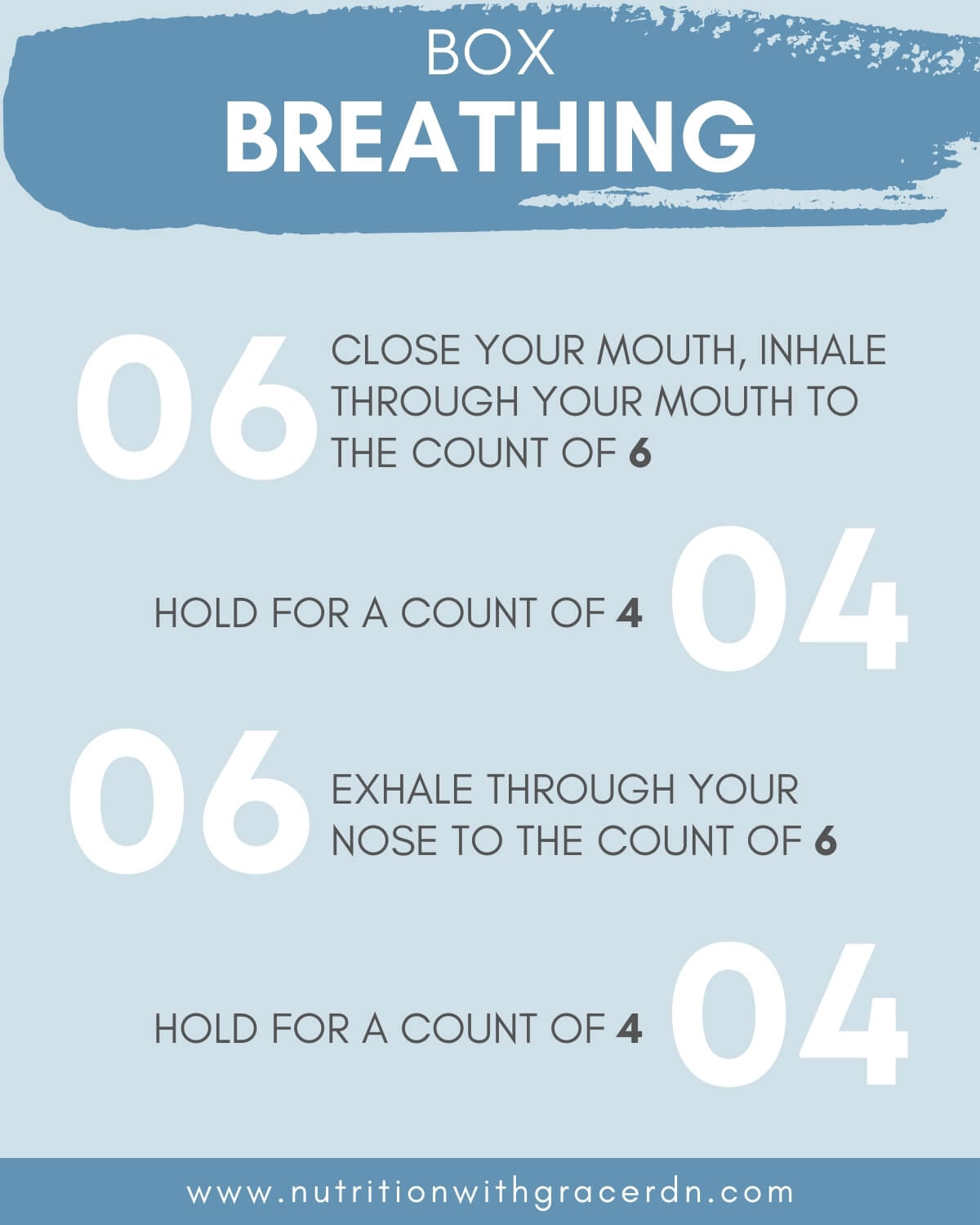
This gently activates your “rest and digest” nervous system, which essentially turns on your digestion and gets your body ready to receive food. When your body can prepare, it has less reasons to activate symptoms.
The Role of Routine in Digestion & Hormones
Your digestive secretions – stomach acid, bile, enzymes – follow a rhythm and so do your hormones.
The two big players we’re concerned about are:
- Cortisol (peaks in the morning to help you wake up and poop)
- Melatonin (rises at night to support restful sleep and gut repair)
When your day has no rhythm, your digestion doesn’t either.
This is why eating at wildly different times each day, skipping meals, or sleeping inconsistently often keeps people stuck – even when they’re eating “all the right foods.”
Signs You Need a Routine Reset
If you see yourself in any of these, pay attention:
- You feel bloated no matter what you eat
- You only poop on weekends
- Your digestion gets worse when work is busy
- You feel worse when traveling or outside of your normal schedule
- Your mornings are so hectic there’s no time to eat or use the bathroom
- You rarely (if ever) eat breakfast
- You spend the majority of your day looking at a screen (computer, phone, TV, etc.)
- You spend the majority of your day inside
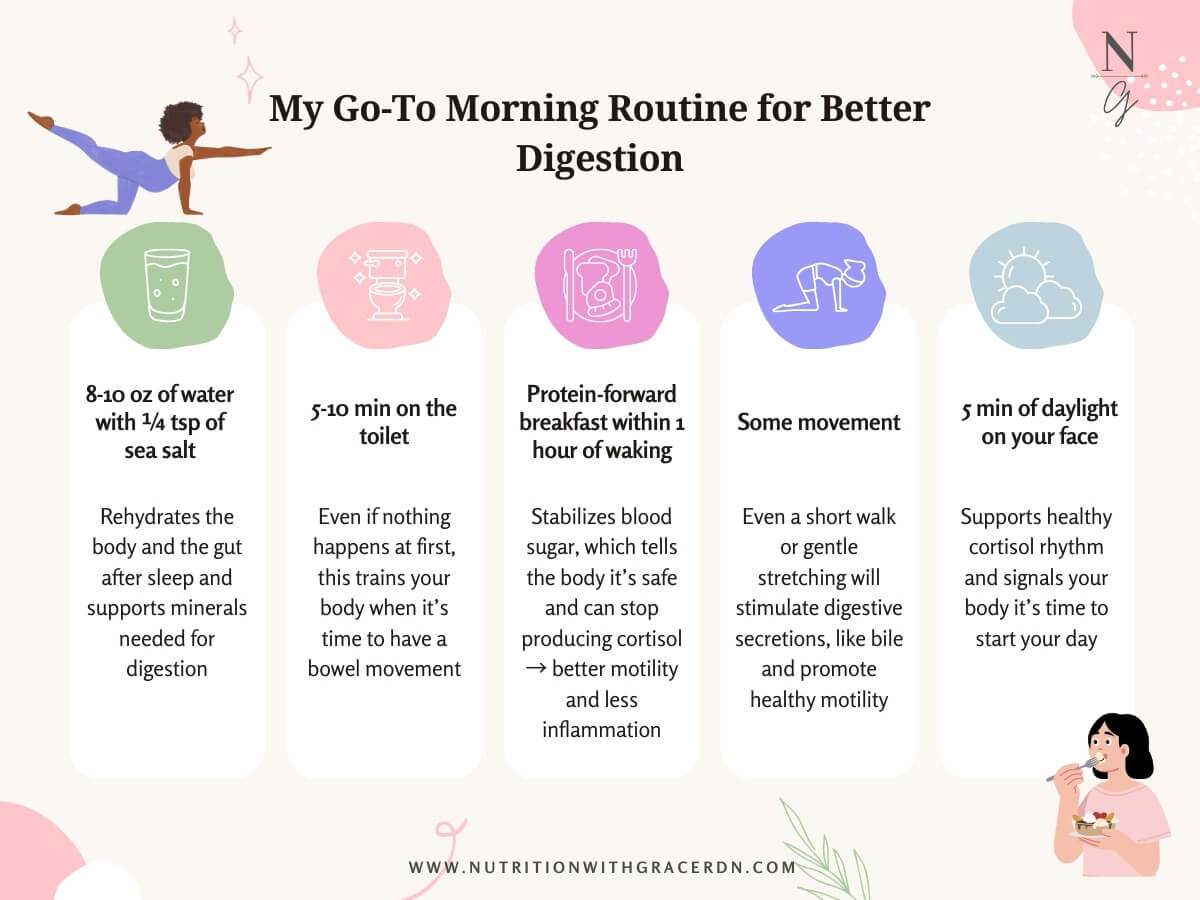
My Go-To Morning Routine for Better Digestion
Let me say this clearly first: This is a template, not a prescription. Perfection is not the goal.
Here’s what I aim for most mornings and why it helps:
- 8–10 oz water with a ¼ tsp of mineralized salt – Rehydrates the body and gut after sleep and supports minerals needed for digestion
- 5–10 minutes on the toilet (even if nothing happens) – Trains your body when it’s time to have a BM
- Protein-forward breakfast within ~60 minutes of waking – Stabilizes blood sugar, which tells the body it’s safe and can stop producing cortisol → better motility and less inflammation
- Some movement (even a short walk or gentle stretching) – Stimulates digestive secretions, like bile and promotes motility
- 5 minutes of daylight on your face – Supports healthy cortisol rhythm and signals your body it’s time to start your day
If mornings are chaotic and finding time for all of this feels hard, start with just one of these:
- Eat something with protein within an hour of waking
- Sit on the toilet for 3 minutes using a squat potty for good positioning
- Step outside for daylight while drinking your water or coffee
What CAN you be consistent with? Doing 1-2 things consistently matters more than doing all the things only some of the time.
My Go-To Bedtime Routine for Better Digestion
Healing doesn’t just happen during the day. In fact, the majority of gut repair happens at night.
What I aim for:
- Magnesium glycinate – this is the best form for relaxation
- Screens off 30–60 minutes before bed – signals the body that it’s time to rest
- Limiting fluids late at night – so I’m not getting up to pee constantly throughout the night
- 8–9 hours in bed – aiming for 7+ hours of actual sleep
- Reading in bed – cues my nervous system to wind down and helps me fall asleep faster
Better sleep = better overnight gut repair = better morning bowel movements.
How to Build a Routine That Fits Into Your Real Life
The implementation phase is where I see a lot of people get stuck because humans are creatures of habit. It can be hard to see a different way of doing things when we’ve been doing them one way for so long.
Here are a few strategies I teach my clients:
- Anchor habits – Stack new habits onto things you already do (ex. Step outside for 5 min while you drink your morning coffee, close the bathroom door and give yourself a few minutes of quiet time to sit on the toilet after you brush your teeth, etc.)
- Find the minimum effective dose – You don’t need a perfect routine, you need a repeatable one. Choose 1-2 shifts to make in the morning and the evening and focus on those until you’re consistent.
- Build for your season of life – Busy mornings, kids, travel, shift work – your routine should be able to flex without breaking.
What Matters Most
Consistency > perfection
Slow changes > rapid overhauls
Personalization > generic protocols
This is where a lot of gut advice goes wrong and why so many women feel like they’re “doing everything right” but are still stuck. The thing to keep reminding yourself of is that you’re not failing, you just haven’t been supported in the right way yet.
Final Thoughts
Building a sustainable routine is part of the foundation, not the finish line. Of course, the “perfect” routine alone is not going to fix your SIBO, IBS, or chronic bloat, but without it, nothing else will stick.
This is exactly how we start inside Heal Your Gut Blueprint 1:1 coaching –by stabilizing your nervous system and daily rhythms in a realistic way before layering on testing and supplements.
This simple strategy is why my clients start seeing less bloat, more predictable bowel movements, and better energy within 30 days of working together – and that’s just the beginning.
If you’re ready to stop guessing and start healing with support that’s personalized to your body and life, you can learn more about working together and book a free Gut Clarity Call.
Your gut doesn’t need more force. It needs consistency, safety, and the right guidance. And you don’t have to do it alone.